Food Sovereignty, first coined by La Via Campesina but advocated for and practiced by hundreds of agrarian communities worldwide, holds immense potential for global transformation; transformation away from capitalistic and industrial pursuits, and towards social and environmental justice, balance and reciprocity. This research explores food sovereignty and subsistence-based living through a case study of Yorkin, a remote pueblo home to a close-knit community of Indigenous Bribri people in the Talamanca region of Costa Rica. For hundreds of generations, the Bribri have relied on their ancestral knowledge of seasonal cues to guide their planting, harvesting, foraging, and hunting to sustain their communities and the natural resources they depend on. However, through centuries of colonization and decades of globalization, Bribri lifestyles, especially pertaining to diet, subsistence practices, religion and gender dynamics have shifted substantially. In an ever-changing world, Yorkin has found a cultural and ecological equilibrium, and food is at its center. Highlighting Yorkin’s experiences and history with food, this research stands as a model from which we can visualize avenues towards transformed food futures that are rooted in justice, sustainability, and regeneration across our food systems.
“Food sovereignty is the right of peoples to healthy and culturally appropriate food produced through ecologically sound and sustainable methods, and their right to define their own food and agriculture systems. It puts the aspirations and needs of those who produce, distribute and consume food at the heart of food systems and policies rather than the demands of markets and corporations.” –La Via Campesina, 2025.
The food sovereignty movement was born out of response to changes in international agriculture policy: In the 1980’s and 1990’s, the World Trade Organization (WTO) added Agriculture to the General Agreement on Tariffs and Trade (GATT). This provided an opportunity for international agribusinesses to engage and compete in foreign markets, resulting in a huge loss of local control over food and food markets, as well as environments, land and rural cultures. These changes exacerbated already-delicate food systems, eventually culminating into an international food crisis in 2007-8. Through this process, ‘food security’ was coined and pedestaled as global aspiration, calling for “all people, at all times, [to] have physical, social and economic access to sufficient, safe and nutritious food that meets their dietary needs and food preferences for an active and healthy life” . Despite its stated intentions, ‘food security’ failed to address how, where, and by whom food would be produced.” Because of this, food security has been leveraged to justify agribusiness bombardment and the neoliberalization of agriculture since its inception. Although alternative models have emerged, like La Via Campesina’s Transnational Agrarian Movement, powerful organizations like the World Bank (WB), the International Monetary Fund (IMF), and the WTO all stand behind neoliberal solutions to the food crisis that advocate for less government intervention, high tech approaches, and increased production using GMO seeds. They call for the alleviation of food insecurity, but do so by helping subsidize food from overseas to prices below production costs: establishing monopolies in foreign markets, making it impossible for local producers to compete, and creating an extreme dependency on imported food in local communities. And yet, these “solutions” do not successfully alleviate hunger. The FAO (2009) found that there was a 25% increase in the “number of people without food” between the mid 1990’s to 2009, even though the frameworks posed by the WB, IMF, and WTO had been fully implemented during this timeframe. This discrepancy in efficacy of the systems in place drove La Via Campesina to speak up, stating, “these contemporary policies aimed at food security offer no real possibility for changing the existing, inequitable, social, political and economic structures and policies that peasant movements believe are the very causes of the social and environmental destruction in the countryside in both the North and the South”. This failure to address the root causes of food inequality and hunger has fueled the food sovereignty movement to advocate for justice through systemic change: returning the control of food to the communities it came from, and redistributing power in equitable, balanced ways.
Zooming in from the broader political and socio-environmental issues of globalized food systems, food itself still holds immense power: in its cultivation, its harvest, its impact on our bodies, and beyond. But in the United States, the process of tending and acquiring food has been taken away from the people. Every food item we could ever need can be found in a single store, within a matter of minutes. While this convenience is amazing, and undoubtedly quite a feat, it’s taken away our access to engagement with food, damaging opportunities to connect and appreciate it. This dissonance is a result of the deliberate invisibilization of food production in the US. Most of us cannot confidently say where our bread was baked, how far our milk travelled to get to us, or what our garlic, beans, or yams looked like when they were still alive. Walking around our neighborhoods, there are hundreds of edible plants growing resiliently around us, but they’ve been written off as weeds, or deemed not economically worthwhile enough to sell and advertise as food. There are students in our communities who believe that the vegetables they eat every day originate in the grocery store. And if they do know that food grows in the ground, they’ve likely learned to believe it grows best alone, in symmetrical rows, stretching for thousands of meters, and tended to by machinery, because that is what they’ve been exposed to.
Despite this disconnected reality in the US, food systems in Yorkin have remained sovereign. Subsistence living is embedded in Bribri culture, making it easy to stay committed to tending the land. But the premise of food sovereignty is that it can take many forms, so long as those cultivating and consuming the food hold the autonomy that is rightfully theirs. Yorkin is a case study, an example from which we can realize that food grows in soil, on our earth, dependent on hands, care and love. Tending sovereign food takes endless forms, and this is merely one of them.
In contrast to the US, the children I passed the time with in Yorkin showed me which plants were food, which ones were medicine, and even where the community tended their crop seedlings. They showed me where their mama grows the holy basil, and told me that they keep it near the home so that when someone gets a stomach ache, their cure is available steps away. They know this because food literacy is inherent to Bribri life, and this is seen throughout the community. Yorkin is covered in fincas | farms, jardines | gardens and semi-wild places. But the farms here don’t look like the ones you may be used to. Instead, they look like this:

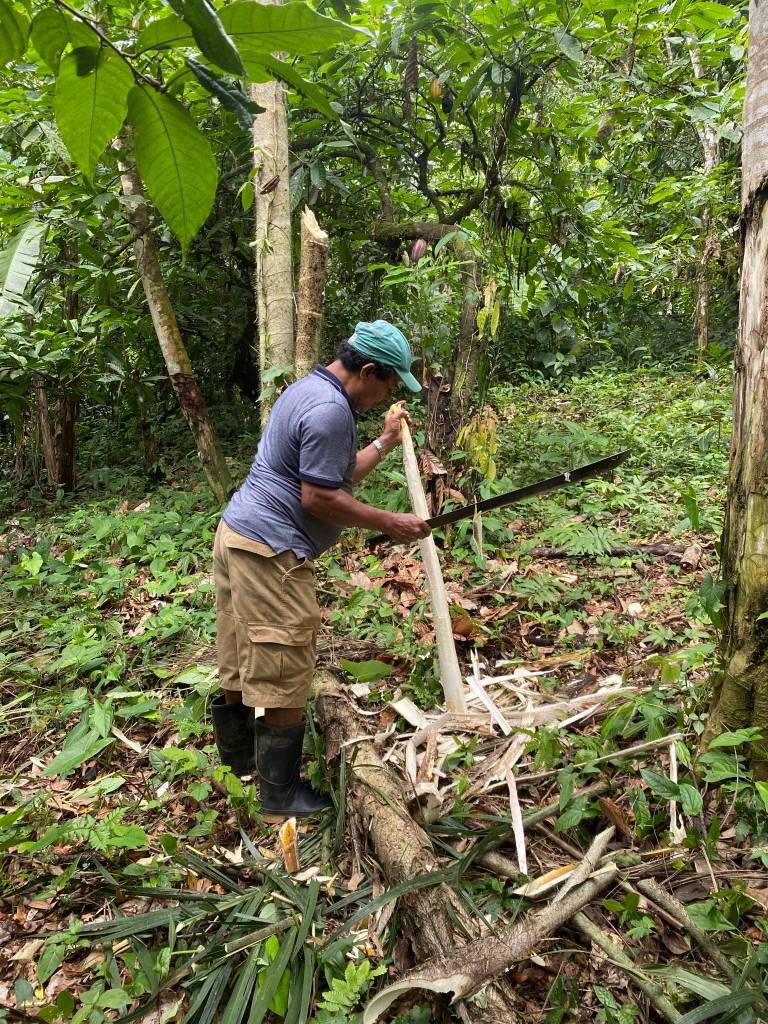
Fincas Integrales are traditional Bribri agroforestry systems that produce food, timber and medicine from the same cultivated field. They support the cultivation of a wide range of necessities in a single, integrated space, from canopy cedro | cedar to craft a canoe, to understory limon dulces | sweet lemons to make agua fresca, to shrubby chaya, a leafy green reminiscent of spinach, all the way to the soil with las raices comidables | the edible roots. On Jacqueline’s farm (pictured above), an Ulé tree towers above the finca, kept upright in its place to protect the crops growing below it, and to conserve an elder tree. Below the Ulé are palmitos (not pictured), a type of palm tree that reaps a nutritious inside known to most as heart of palm. The trunk of this tree is covered in spines, as though it’s learned how coveted it is. Palmito grows well on fincas, but also thrives in the wild. They take time to process and harvest, but the result is worth the wait.
Alongside the palmitos are fruit trees: cacao, plantain and banana, but also zapote, mamones, and various limon varieties. Underneath this second story are saplings and shrub-sized crops, including spinach, squash and chiles. Then, underneath the soil are the yucca, yam, potato, and other tubers.
“El sistema de nosotros de cultivar es integral, es un cultivo enfocado, nosotros nos enfocamos en poder obtener lo que necesitamos en la finca. Entonces no nos dedicamos solamente a una cosa, nosotros necesitamos por ejemplo madera para las casas, entonces la madera debe estar en la finca, se debe conservar. Entonces por eso es que en la finca se va a encontrar laurel, se va a encontrar cedro, se va a encontrar diferentes árboles de madera que generalmente está en la montaña, pero también los sembramos en las fincas para que poder tenerlo. Entonces nosotros necesitamos también el cacao, que es nuestra bebida tradicional, también debe estar en la finca. Entonces el cacao se siembra en más cantidad, porque además de ser nuestra bebida, pues también se comercializa. Entonces en la finca va a haber bananos, variedad de bananos, va a haber plátanos y también lo que son raíces que son como la yuca, el ñame, ñampí, todo eso va a estar en la finca. Nosotros también ocupamos frutas y todas las frutas de la finca, vas a encontrar naranjas, limones, limón dulce, mandarina, cas, carambolas, todo eso está en la finca. También en la finca, hay pipas, cocos para la cocina, para comer, para los animales. También plantas medicinales, ahí tenemos jengibre, cúrcuma y las plantas medicinales naturales que de la zona que nacen, que no se cultivan, sino que nacen solas, todo eso lo tenemos de la finca. Entonces la finca, por eso es que te digo que es integral, porque en la finca se trata de tener todo lo que usted necesita. Entonces, así es como se ha trabajado. Ahora, en lo que es la tierra, se trabaja natural. ¿Por qué? Porque las mismas hojas, lo mismo que cae de la finca es el abono de la tierra. Entonces es una tierra que siempre es productiva, no es una tierra que pierde todos sus nutrientes. No, claro. ¿Verdad? Con todo esto del cambio se ha dañado y ha sufrido. Es que no. Pero la tierra que se mantiene con este sistema es una tierra que es productiva, que si usted siembra probablemente va a cosechar. Mientras que una tierra que se hace monocultivo, una sola planta, se usa químico, es una tierra que se vuelve árida.” | “Our cultivation system is integral, it’s a focused cultivation. We focus on obtaining whatever we need from the farm. So we don’t dedicate ourselves to just one thing, we need for example wood for the houses, so the timber should be in the farm, we should conserve it. So in our farms you can find Laurel, you’re going to find Cedar, you’re going to find different timber trees that are generally in the mountains, but we plant it here in the farms as well so that we can have it near. So we also need to grow cacao, as this is our traditional drink, it should also be in the farm. So the cacao we plant in larger quantities, because in addition to being our drink, it is also a commercial product. So in the farm you’re going to have banana, many varieties of banana, you’re going to have plantain, and also the roots like yucca, yam, and ñampi (local tuber variety), all of this is going to be in the farm. We also need fruits, and all of our fruits can be found in the farm, you’re going to find oranges, lemons, sweet lemons, mandarins, cas (Costa Rican guava), starfruit, all of this is in the farm. Also in the farm are coconuts, for the kitchen, to eat, for the animals. Also medicinal plants, there we have ginger, turmeric, and the medicinal plants that grow naturally in this zone, that don’t need to be cultivated, because they grow on their own, all of this we have on the farm. So the farm, this is why we call it integral, because the farm tries to have everything that you need. So, this is how it works. Now, in what is the land, we work naturally (organically). Why? Because the same leaves, the same ones that fall on the ground are the fertilizer of the soil, it works naturally. Of course, right? With all this change maybe its suffering, but no. The land that maintains itself with this system is a productive land, if you plant something in this, you will likely harvest it. Meanwhile, land used to grow monoculture, only one plant, uses chemical fertilizers, and that land becomes barren.” –Saolin Morales Morales
Sophia: ¿Y la mayoría de la gente aquí en Yorkin tratan a las fincas así? | And the majority of the people here in Yorkin treat their farms like this?
“Sí, a excepción de los que se han metido en plátano. Generalmente el plátano usted lo va a encontrar a esa orilla del río y es por lo mismo, porque el plátano arrasa con todo. Pero el plátano con químico, porque el plátano natural no hay problema, usted lo cosecha entre la finca. El plátano con químico es que se quita todo árbol, es a pleno sol. Entonces los que donde hay plátano no vas a ver esos niveles, porque solo hay plátano.” | “Yes, with the exception of those who work in plantains. In general, the will find plantain on that side of the river and it is for a reason, because that plantain ruins everything. But the plantain with chemicals, because the natural plantain, there are no problems, you can harvest it within the farm. The plantain treated with chemicals eliminates every other type of tree, and sits in full sun. So where the monoculture plantain grows, you will not see those three tiers (of the integral farm), because there is only plantain.”
Sophia: “¿Y la gente que cosechan el puro plátano viven aquí en Yorkin? | And the people who harvest the monoculture plantain live here in Yorkin?”
“Mhm (si)” | “Yes”
Sophia: “¿Y hay alguna distinción entre las personas que crecen sus fincas así y las personas que crecen sus fincas así?” | “And is there any diction between the people who grow their farms like this (integrally) and the people who grow their farms like that (monocultural)?”
“Yo pienso que la diferencia está en que, al menos yo puedo decir que uno trae esto ya como conciencia de tu enseñanza, los abuelos transmitieron esa enseñanza a mi mamá, mi mamá la ha conservado, mi mamá me pasó esa enseñanza a mí, yo la he conservado, ahora yo estoy tratando de pasársela a mis hijos para que puedan seguir conservando y teniendo lo natural. Pero esto es una cuestión de que hay de transmitir, de transmisión, porque es la forma del sistema del indígena, puede transmitir el conocimiento o el estilo de vida. Pero no sé si igual ya te hablaron de esta parte igual y hablemos de cómo invasión, digamos invasión, han venido otros que han hecho estos sistemas, entonces ya algunos dicen le ha gustado ese sistema por el comercio, por la economía, digamos que se negocia, entonces se fueron involucrando otros. Ahora, también tiene que ver que no toda la población de Yorkin está con esa ideología de conservar, de cuidar.” | “I think that the difference is in, at least I can say that one comes with this, like, the consciousness of your teachings. My grandparents transmitted this knowledge to my mother, and my mother conserved it, and passed it down to me. Now I conserve it, and now I’m trying to pass it along to my sons so that they can continue conserving and tending [the farm] naturally. But this is a question of transmission, because it is the form of our Indigenous system, it can transfer the knowledge or the style of our lives. But I don’t know if I already spoke with you about this part, if we’ve already talked about this, like, invasion. Not invasion, but other people have come and made these other systems, and some have decided that they like these other systems better, for the commercial opportunity, from an economical point of view, so they negotiated, and some people became involved in it. So, it’s also important to remember that not all of the people in Yorkin are with this ideology of conserving, of taking care [of nature].” -Saolin Morales Morales
Aside from the fincas comerciales | commercial farms, the families in Yorkin grow their fruits, roots, herbs and vegetables independently, en su propia finca | on their own farm, sharing their spare harvest with one another, and prioritizing the mouths of their community before considering selling any of it. However, while most residents have maintained their ability to grow fruits, roots and vegetables, few are able to commit time and energy to the staple crops: rice, corn and beans. As discussed in Climate Experiences, these staple foods are increasingly difficult to grow due to changes in seasonality. Because of this, the are growing numbers of residents who purchase their rice and beans from the local pulperias | convenience stores. Those who continue to grow el arroz, el maiz, y el frijol do it for the sake of tradition, or because it is what they know.
“Nosotros somos un territorio grande. Esta parte acá abajo son maestros, trabajan con el gobierno, trabajan en turismo, pero los que están aquí en la parte alto dependen de eso, el arroz, maíz, frijoles. Aquí cerca de nosotros tengo un primo que vive aquí como hora y media allá arriba. Y él no vende cacao, no vende banano, no hace turismo, nada. Él tiene arroz y viene aquí, vende su arroz a alguien que quiere y compra su sal, compra su aceite o lo que ocupa y vuelta se va. Así como él, hay muchas personas hacia arriba que no venden. No, no se, me pongo a ver de que comen? A veces yo digo que ustedes venden aquí cuando? Dice que ‘nosotros no vendemos, nosotros cosechamos arroz, cosechamos maíz, frijoles y tenemos las gallinas. Y si queremos dinero, agarramos un cerdo y lo matamos, vendemos la carne y compramos lo que necesitamos.’ O sea, ellos no están pensando en dinero, ellos están pensando en tener su comida simplemente por eso.” | “We are a large territory. This part down here (Yorkin) has teachers, people who work with the government, people who work in tourism. But those who live higher here in the mountain depend on this, the rice, corn, beans. Here close to us I have a cousin who lives about an hour and a half up. And he doesn’t sell cacao, he doesn’t sell banana, he doesn’t work in tourism, nothing. He grows rice and he comes here, sells his rice to anyone who wants it and uses the money to buy salt, to buy oil, or whatever he needs and returns home. Like him, there are many people living up the mountain that don’t sell. I, I don’t know, it makes me wonder what they eat. Sometimes I ask them when they sell here, they say “No, we don’t sell, we harvest rice, we harvest corn, beans and we have the chickens. And if we need money, we grab a pig and kill it, we sell the meat and we buy what we need.’ This is to say, they aren’t thinking in terms of money, they’re thinking about having food, simply put.”
“Lo que ocupamos nosotros para la felicidad es la salud. Porque nadie quiere estar enfermo, queremos estar bien para hacer nuestro trabajo, para nosotros hacer lo que queremos, para tener nuestra comida, para criar nuestros hijos. Esa es la felicidad para nosotros. Ellos creen que tal vez nosotros sin dinero estamos tristes. Nosotros lo único que uno se pone triste es cuando alguien está enfermo, pero mientras tenemos salud, tenemos la comida. Y eso es lo que yo quiero que la mayoría de nuestra gente entiendan, porque como le digo, la parte de aquí ya se acostumbraron con el dinero, no pueden estar sin dinero. La parte de aquí, en la parte alta de Talamanca dedican el tiempo a estos trabajos, ellos no les interesa el dinero. Ellos viven felices, nosotros pues vivimos, vivimos felices con la tierra, por la naturaleza, con la comida que Dios le da a uno.” | “What we need to be happy is good health. Because nobody wants to be sick, we want to feel good so that we can do our work, so that we can do what we want to do, eat our food, take care of our children. This is happiness for us. They think that maybe we’re sad without money. The only thing that makes us sad is when someone is sick, but when we are healthy, we have our food. And this is what I want the majority of our people to understand, like I said before, the people down here (in Yorkin) are already accustomed to having money, they can’t be without money. The part up here, in the higher regions of Talmanca, dedicate themselves to this work, they aren’t interested in money. They live happily, we, well, we live happily with the land, with nature, with the food that God gives us.”
Sophia: “Y usted se siente en la mitad de las dos partes de la montaña, porque usted trabaja con STIBRAWPA, pero usted no ocupa dinero para comprar muchas cosas, solo para vivir.” | “And do you feel in the middle of these two parts of the mountain? Because you work with STIBRAWPA, but you don’t need money to buy many things, only to live.”
“No necesito mucho dinero para comprar cosas, pero sí necesitamos para trabajar. Por ejemplo, para cosechar el arroz yo tengo que llevar a alguien que me ayude y tengo que pagarle, porque yo [solo] cómo puedo, entonces por lo menos le doy un dinero. Entonces yo necesito la plata para ayudar al medio ambiente, para que las personas no tengan que tal vez buscar plata otro lado. Y no sólo con el arroz, con el cacao, porque hay que sembrar más cacao, que hay que chapear el cacao, que hay que cosechar el cacao. Entonces como ya somos dos nada más, ya mis hijos se fueron, necesito alguien que me ayude. Entonces el dinero que yo garro, yo necesito es para ayudar, trabajar en mis fincas, trabajar mis cosas, no para comprar cosas, que no es necesario eso.” | “I don’t need much money to buy things, but I do need money to work. For example, to harvest the rice, I have to bring someone to help me and I have to pay them, because how could I do it alone? So at the very least, I give a little money. So I need money to help the environment, so that the people I pay don’t try to look for money in other (extractive) ways. And not just with the rice, but also the cacao, because we always need to plant more cacao, trim the cacao, and harvest the cacao. And here we are just two, my children have already moved out, I need someone to help me. So the money that I earn, I need it to pay for help, for those who work on my farm, not to buy things, that isn’t necessary for me.” -Mirian Morales Marin
Yorkin’s positionality within the Bribri Indigenous Zone makes it a particularly interesting community to analyze under the themes of this research. While Yorkin is quite remote and distinct from larger, more centrally-located towns like Bribri and Suretka, it is less remote and more “modernized” than the towns and barrios that can be found higher up in the Cordillera mountain range. Many residents in Yorkin have relatives who live more remotely, meaning they are especially dependent on their subsistence practices. In contrast, there are many Yorkin residents who have families in larger towns that have access to electricity, buses, highways, restaurants, and other modern amenities. Yorkin’s characteristics fall somewhere en la mitad de | in the middle of these realities, and there are mixed emotions around the direction that the pueblito is headed in. Because of this, Yorkin sits at a crossroads, where residents have the choice to commit to their traditional subsistence practices and prioritize the growing of their food, or to step back from it and commit to working. Currently, many residents are juggling both. Despite a growing need for income, subsistence practices are deeply entwined with ancestry and tradition in Bribri culture.
Prior to Spanish colonization of the Americas, the Bribri were seasonal dwellers. They would rotate the lands that they resided on once the foraged food supply ran low. They took advantage of natural plains where trees didn’t grow and established camps there, so as not to damage la naturaleza. They crafted tools and weapons out of the resources around them to hunt, and foraged for all their food.
“Dios no nos dejó machete, no nos dejó lápiz, no nos dejó cuaderno, nada, simplemente lo que era la naturaleza. Entonces nosotros no sembrabamos, nosotros cosechamos las cosas que ya habían en el bosque, como plantas que se pueden comer, como flores que se pueden comer, como raíces que se pueden comer, hongos que se pueden comer, animales, aves, pescados. Todo eso se hacía con la mano sin ningún tipo de herramientas que uno pueda decir que es hecho por el hombre, sino cosas que nosotros usamos de la naturaleza, materiales de la naturaleza. Por ejemplo, la lanza era de un tronco que uno lo fabricaba de la misma naturaleza, un tronco más que todo se usaba la palma de gira para hacer los arcos, los arpones para matar animales, entonces eso y se usaban fibras que nosotros sabemos sacar de los árboles para ponerle al arco. Entonces no había que comprar nada, todo estaba ahí.” | “God didn’t leave us the machete, he didn’t leave us pencils, he didn’t leave us notebooks, nothing. Simply what was in nature. So we didn’t plant food, we harvested the food that was already in the forest, like plants you can eat, flowers you can eat, roots/tubers you can eat, mushrooms you can eat, animals, birds, fish. All of this you could do with your hand, without any tools that one could say was man made, just items from nature, materials from nature. For example, the spear was made from the trunk of a tree, fabricated from nature, a trunk that most often was a palm tree to make bows and harpoons to kill animals. They used fibers that we know to get from the trees to make the bows. So there was no need to buy anything, everything was already there.” -Mirian Morales Marin
When the settler lifestyle and farming were introduced to the Bribri people, it turned into tradition through generations of reaccustoming. Families continued to pass down their ecological knowledge, but farming became a new avenue to employ it in. Land became inheritance, as did the farm. Children growing up in the rural areas of the Bribri Indigenous Zone watched their parents harvest, grow, and craft all that they needed to live, and would learn the process and continue it, eventually passing it down to their children, and so on. But Yorkin, along with its neighboring towns, villages and cities, is still recovering from centuries of cultural erasure by Spanish colonists. Bribri language was banned in schools until the late 20th century, and children were punished if they didn’t speak Spanish. Bribri culture is dependent on its language, so that its stories, folklore, and memories may be passed down from elders to their kin. Because of these bans, many generations of Bribri people did not get to experience Bribri language exchanges, and some families lost the language altogether. Today, many younger generations do not speak Bribri, or they choose not to use it often. For these reasons, along with many other influences, Bribri culture in Yorkin is fragmented. But tending the family land has become a way to stay connected to ancestral practices. Because of this, cultivating food is not a question of if, but of how: how these traditions can endure while residents adapt to the multifaceted changes unfolding in this small yet mighty community.
Yorkin’s story is one of grief, reconciliation, determination, and hope. Its foodways exemplify many of the core ideas behind food sovereignty, which calls for a radical reimagining of how food is produced, valued, and controlled. While Yorkin’s context is singular and unique, its approaches to land and food offer meaningful lessons to those accustomed to Western notions of agriculture: profit-driven, maximized efficiency, no matter the cost.
“Food sovereignty challenges not just a particular development model, doesn’t just challenge a particularly abhorrent form of neoliberalism, doesn’t just suggest a new set of rights. Rather, it envisions fundamental changes in the basis of modern society. Modern society was based on a set of exclusions and enclosures that were fundamental to the emergence and strengthening of capitalism. Those exclusions were felt primarily in the countryside and primarily in agriculture. Capitalism was dedicated to divorcing producers from any right over the goods they produced and encasing those goods in ever larger, ever more disconnected, ever more monopolized, and ever more destructive markets. Food sovereignty challenges all of that because it demands that we rethink what was at the very centre of this transition; it demands that we treat food not simply as a good, access to which and the production of which is determined by the market, it demands that we recognize the social connections inherent in producing food, consuming food, and sharing food. In the process it will change everything.” -Jim Handy, 2007
These words find living expression in the farms, families, and communal spaces of Yorkin. Las Fincas Integrales | The Integral Farms, and other Bribri ways of knowing, tending, and respecting food, and thus nature, challenge Western understandings of what it means to know the land, and know our food. Yorkin’s foodways are just, people-centered, communally powered, and oriented with nature in mind. This sovereign system not only exists: it thrives. In Yorkin, food transcends sustenance, and embodies memories, resistance, and transformation.
Primary resource for Food Sovereignty background:
Wittman, H., Desmarais, A., Wiebe, N. 2010. Food Sovereignty: Reconnecting Food, Nature and Community. Fernwood Publishing. https://www.researchgate.net/publication/274455797_Food_Sovereignty_Reconnecting_Food_Nature_and_Community
 Phases and Faces of Change | Fases y caras de Cambio